
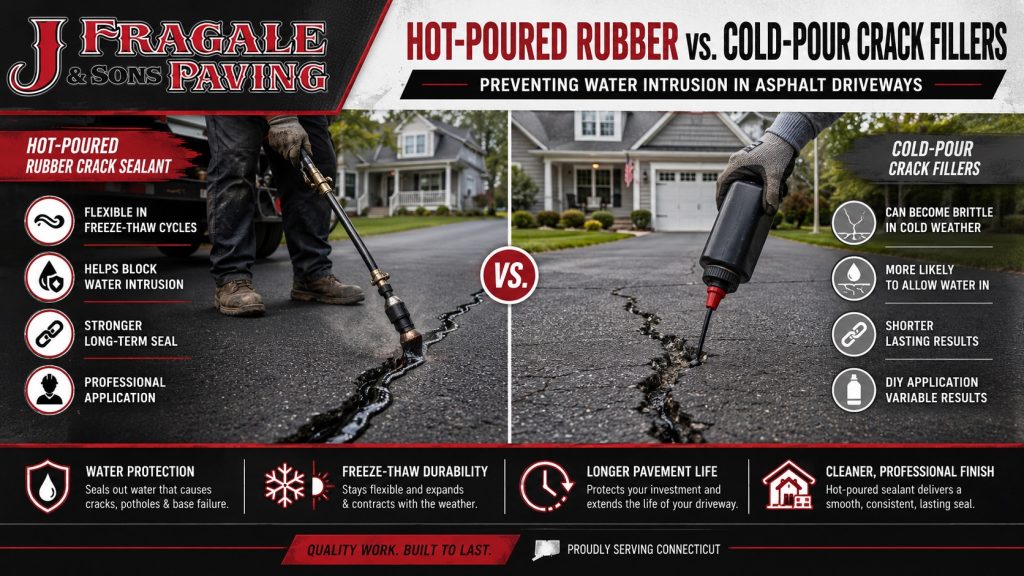
For working asphalt cracks that expand and contract through Connecticut temperature swings, hot-applied rubberized crack sealant is generally the stronger professional repair option. Hot-pour materials use an asphalt base modified with rubber or other polymers to improve flexibility, helping the seal remain bonded as cracks open during cold weather and tighten during warmer conditions. Common consumer cold-pour asphalt-emulsion fillers are easier for DIY repairs, but product performance varies and many are better suited to smaller, lower-movement cracks. At J. Fragale & Sons Paving, we focus on stopping water before it reaches the pavement base because moisture, freezing, and thawing can turn a manageable crack into heaving, settlement, potholes, and structural asphalt failure. FHWA research confirms that crack treatments are used to reduce water infiltration and extend asphalt pavement life.
Why Asphalt Cracks Become a Bigger Problem in Connecticut
A narrow driveway crack may seem cosmetic during summer.
Once rain or snowmelt enters that opening, the problem moves below the asphalt surface.
Water can reach the stone base and surrounding soil. When temperatures fall below freezing, trapped water expands. When thawing occurs, saturated base material can lose support and settle.
That repeated freeze-thaw movement can produce:
- Wider cracks
- Depressed pavement
- Frost heaving
- Edge breakup
- Potholes
- Alligator cracking
- Premature driveway replacement
Our asphalt maintenance services focus heavily on crack filling and drainage because keeping the base dry is critical to long-term pavement performance. J. Fragale & Sons Paving notes that water penetrating to the base can freeze, heave the pavement, and leave an uneven surface after thawing.
Hot Rubber Crack Filler: How It Works
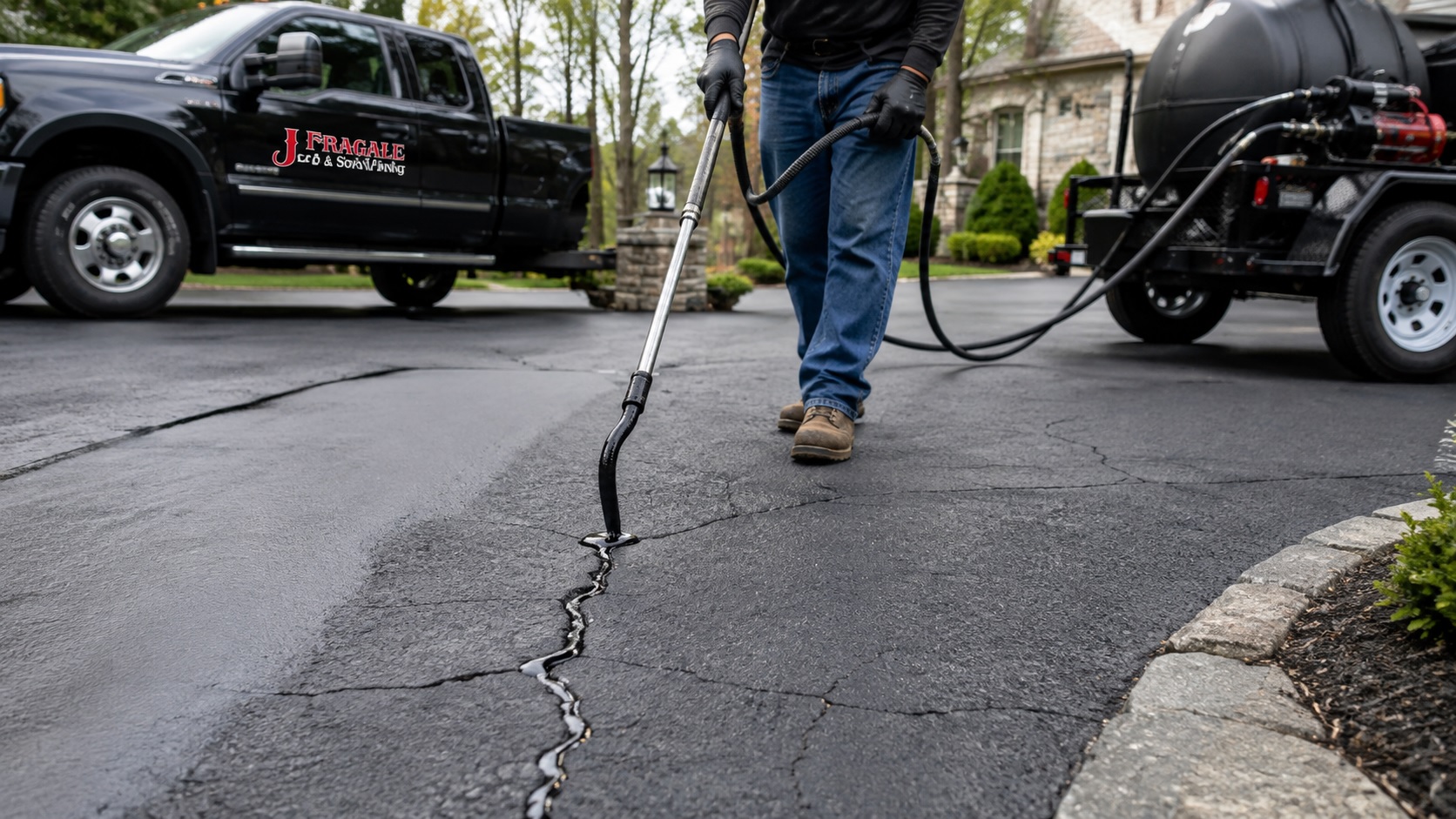
Professional hot rubber crack filler for a driveway begins as a solid or block-form sealant that is heated in specialized equipment until it reaches the manufacturer’s specified application temperature.
The molten material flows into the prepared crack and bonds to the asphalt edges. Once cooled, the material remains flexible rather than behaving like a rigid patch.
According to the Asphalt Institute, hot-pour crack sealants use asphalt cement as their base and are modified with rubber and other materials.
That flexibility matters in New England.
FHWA guidance explains that softer, more flexible sealants are appropriate in colder climates where pavement cracks experience larger seasonal movement. Proper installation allows the sealant to accommodate crack expansion without prematurely debonding or cracking.
Hot-Pour Crack Sealing Works Best For
- Transverse temperature cracks
- Longitudinal cracks
- Working cracks that change width seasonally
- Residential driveways
- Commercial parking lots
- Private roads
- Pavement receiving preventive maintenance
The crack still needs proper preparation. Dirt, vegetation, moisture, and loose asphalt can prevent even high-quality material from bonding correctly.
What About Cold-Pour Crack Fillers?
Cold-pour products offer convenience.
Most homeowners can open a container, pour or squeeze the material into a cleaned crack, smooth it, and allow it to cure without specialized heating equipment.
That makes cold filler useful for certain small DIY repairs.
However, cold-applied does not automatically mean rigid or ineffective. Formulations vary considerably. The real question is whether a particular product has enough adhesion, elasticity, and temperature resistance for the crack being repaired.
Common consumer asphalt-emulsion fillers may be better suited to relatively stable cracks with limited seasonal movement. FHWA distinguishes crack filling from crack sealing based partly on movement: highly flexible sealants are recommended for working cracks, while filling methods can be appropriate where annual crack movement is limited.
Hot-Pour vs. Cold-Pour Asphalt Crack Repair
| Factor | Hot Rubberized Sealant | Common Cold-Pour Filler |
|---|---|---|
| Application | Heated professional equipment | Ready to apply |
| DIY friendly | Low | High |
| Working cracks | Excellent when properly selected | Product dependent |
| Freeze-thaw flexibility | High with proper formulation | Varies |
| Preparation required | Thorough | Thorough |
| Cure/setup | Cools relatively quickly | May require longer curing |
| Best use | Preventive professional sealing | Smaller DIY repairs |
| Equipment cost | Higher | Minimal |
Neither product can repair structural base failure.
If cracks have developed into widespread alligator patterns, deep depressions, potholes, or major heaving, pouring sealant into them treats the symptom rather than the cause.
How to Fix Driveway Cracks Properly
For homeowners researching how to fix driveway cracks, we recommend starting with the type of failure rather than choosing filler based only on price.
1. Inspect the Crack
Straight thermal cracks may be candidates for sealing.
Alligator cracking usually indicates deeper pavement or base deterioration and may require patching or reconstruction.
2. Clean It Thoroughly
Remove vegetation, stones, dirt, and loose asphalt.
Good adhesion requires clean crack walls. FHWA pavement guidance repeatedly emphasizes surface preparation as a major factor in successful repair.
3. Keep the Crack Dry
Moisture inside the opening can interfere with adhesion.
Professional crack-sealing equipment and procedures are designed around proper cleaning and suitable application conditions.
4. Apply the Correct Material
Working cracks need a material capable of stretching and recovering as pavement moves.
The FHWA asphalt crack-sealing guidance explains how climate, crack movement, pavement condition, material properties, and installation methods affect sealant performance.
5. Address Drainage Too
Crack repair works best when surface water also has somewhere to go.
Standing water, poor driveway pitch, damaged shoulders, and saturated base material can continue weakening pavement even after surface cracks are sealed.
What Determines Asphalt Crack Repair Cost?
Asphalt crack repair cost depends more on pavement condition than driveway square footage alone.
Major factors include:
- Total linear feet of cracking
- Crack width and depth
- Cleaning or routing requirements
- Hot-pour vs. cold-applied material
- Number of damaged areas
- Accessibility
- Existing potholes
- Base failure
- Drainage problems
- Sealcoating or patching performed afterward
Treating cracks early is usually far less involved than repairing pavement after water has damaged the base.
Our guide to protecting Connecticut driveways from freeze-thaw damage explains why open cracks should be repaired before sealcoating and before winter moisture reaches underlying pavement layers.
Stop Water Before It Reaches the Base
At J. Fragale & Sons Paving, we view crack sealing as preventive pavement maintenance, not simply a cosmetic improvement.
For Connecticut driveways and parking lots, properly selected hot rubberized sealant can accommodate seasonal crack movement while reducing one of asphalt’s biggest threats: water infiltration.
Catching those cracks early can help protect the base, slow freeze-thaw deterioration, and postpone much more expensive asphalt repairs.