

An existing gravel driveway can often be converted to asphalt, but asphalt should not simply be placed over loose stone. A successful gravel driveway prep for asphalt starts by evaluating the soil below the stone, removing organic material and unstable areas, confirming drainage, reshaping the existing aggregate, adding processed gravel where needed, and compacting the base before paving. The Asphalt Institute notes that the subgrade must be properly graded and adequately compacted because it acts as the foundation supporting the pavement system. At J. Fragale & Sons Paving, we recommend a properly constructed processed-gravel base for residential driveways because asphalt cannot correct movement or weakness underneath it.
Can You Pave Over a Gravel Driveway?
Sometimes, but the condition of the existing gravel matters more than how the surface looks.
A driveway that has carried vehicles for years may already have a reasonably compacted base. That does not automatically make it ready for asphalt.
Before paving, we look for:
- Soft or pumping areas
- Deep tire ruts
- Standing water
- Organic soil mixed with stone
- Loose rounded gravel
- Poor driveway pitch
- Buried roots or stumps
- Uneven base thickness
- Areas that move under heavy equipment
The Federal Highway Administration explains that granular base layers help distribute stress to the subgrade, improve drainage, and provide structural support beneath pavement. Dense, angular aggregate is preferred where stability is required.
That is why simply covering loose decorative gravel with blacktop can lead to premature settlement.
Step 1: Inspect the Existing Gravel and Subgrade
The first stage of converting a gravel driveway to asphalt is determining what was originally installed.
Some stone driveways have several inches of properly processed aggregate over stable soil. Others may contain only a shallow layer of stone spread directly across topsoil.
Those two driveways require very different preparation.
When weak areas are discovered, we may excavate until stable material is reached. Soft soil, roots, organic debris, and mud should not remain underneath the future pavement.
The Asphalt Institute specifically recommends identifying unstable subgrade areas before paving and replacing unsuitable material when additional compaction cannot correct the problem.
Step 2: Remove Organic Material and Soft Spots
Topsoil is excellent for lawns but poor for supporting asphalt.
Organic soils can compress as moisture conditions change and organic matter decomposes. Once that movement occurs, the asphalt above can sink or crack.
Common warning signs include a driveway that develops the same depression every spring or sections where tires repeatedly push gravel downward.
We excavate these unstable locations and rebuild them with appropriate aggregate instead of expecting thicker asphalt to bridge the weakness.
Our paving preparation service explains why we focus so heavily on what sits beneath the finished blacktop.
Step 3: Rebuild and Compact the Gravel Base
The existing stone does not always need to be discarded.
When the aggregate is suitable, it can often become part of the new pavement structure after reshaping and compaction.
At J. Fragale & Sons Paving, our residential paving approach commonly calls for approximately 12 inches of processed gravel when constructing a complete driveway base. Actual requirements depend on existing material, soil conditions, drainage, expected traffic, and site conditions.
Processed gravel contains a controlled mix of stone sizes and fines that locks together during compaction.
The goal is not merely to make the driveway look flat. The goal is to create a dense structural platform that resists vehicle loads and seasonal ground movement.
Step 4: Compact the Base in Controlled Layers
Compaction is one of the most important steps in gravel driveway prep for asphalt.
Dumping a thick layer of gravel and rolling only the top can leave loose material deeper within the base.
Proper construction may require aggregate to be placed, graded, and compacted progressively so the full depth becomes stable.
FHWA guidance emphasizes that compaction of subgrades and unbound pavement layers is a key part of pavement performance.
Heavy rollers also help expose weak areas before asphalt is installed. Finding movement during preparation is much less expensive than repairing a settled paved driveway later.
Step 5: Correct Drainage Before Paving
Water can turn a strong-looking driveway base into a weak one.
The finished driveway needs sufficient pitch to move rainfall and snowmelt away from the pavement, buildings, and vulnerable edges.
Depending on the property, drainage work may include:
- Regrading
- Crowning
- Swales
- Culverts
- French drains
- Edge drainage
- Redirecting roof runoff
The Asphalt Institute identifies good drainage as an important part of driveway pavement construction, while FHWA notes that base and subbase layers contribute to pavement drainage and frost protection.
That matters especially in Connecticut, where water trapped within the base can contribute to freeze-thaw movement.
Step 6: Fine Grade Before Asphalt Installation
Once the base has been repaired and compacted, we establish the final elevation and pitch.
Asphalt follows the shape of the base underneath it.
We often describe paving as laminating the prepared base. Asphalt creates the finished driving surface, but it does not magically eliminate depressions, unstable soil, or poor drainage underneath.
A smooth, properly pitched gravel surface is therefore one of the best predictors of a smooth finished driveway.
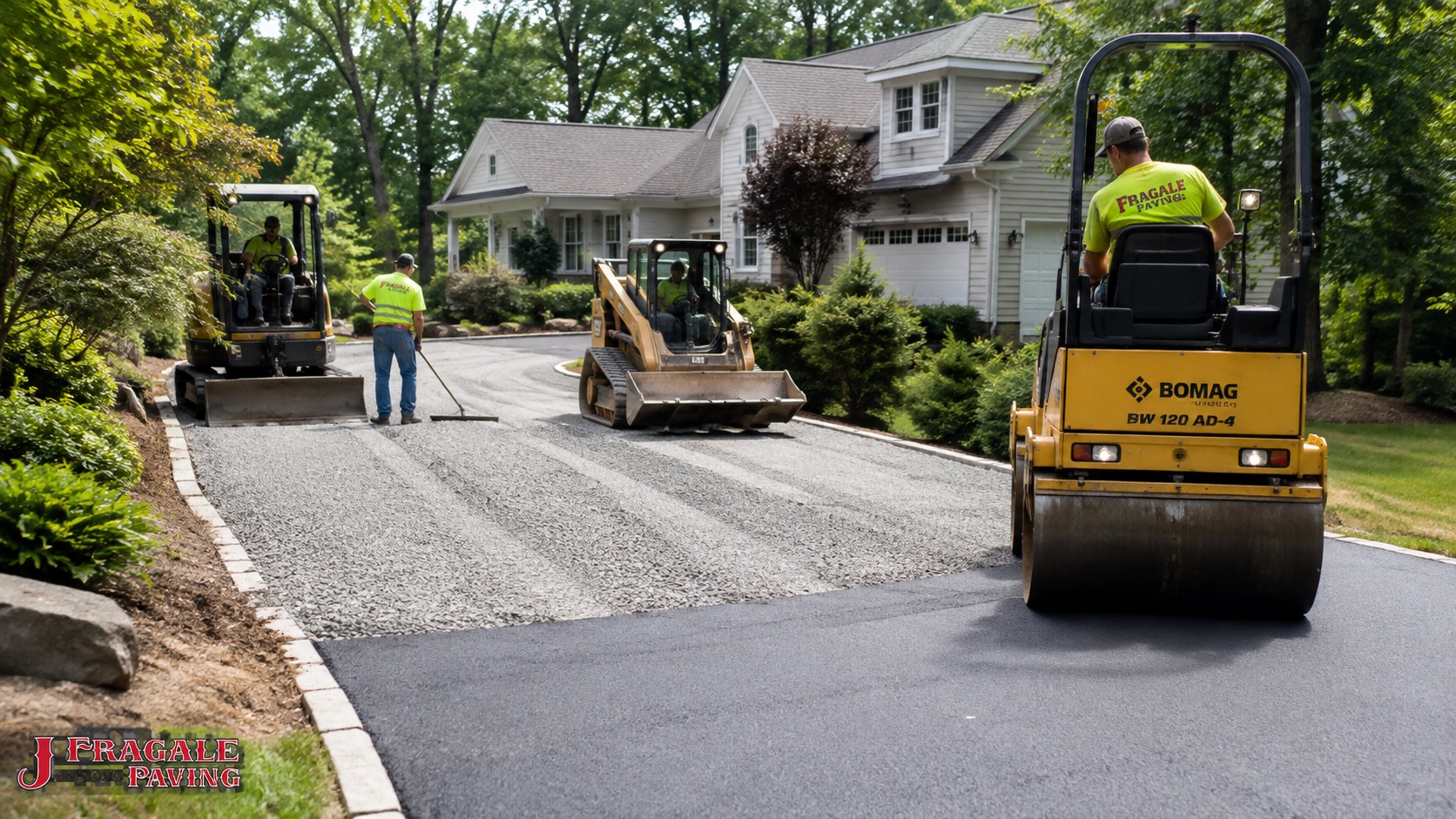
Why Gravel-to-Asphalt Driveways Sometimes Settle
Most early settlement problems trace back to what happened before paving.
Common causes include insufficient excavation, uncompacted fill, buried organic material, inadequate gravel depth, poor drainage, and asphalt installed over existing soft spots.
Homeowners planning a conversion can also review our related guide, How to Prepare Your Property for a New Asphalt Driveway, which covers grading, excavation, base construction, and drainage planning.
Upgrade Your Gravel Driveway Without Building Problems Into the Asphalt
A properly built gravel driveway can provide a valuable head start for asphalt conversion. A poorly built one needs to be corrected before paving begins.
At J. Fragale & Sons Paving, we handle the complete gravel-to-asphalt process, including excavation, subgrade correction, processed gravel installation, grading, compaction, drainage preparation, and asphalt paving.
Ready to convert a stone driveway into smooth blacktop? Contact J. Fragale & Sons Paving for a gravel driveway asphalt conversion evaluation and paving estimate.