

An asphalt driveway apron is the transition area where a private driveway meets the street, curb, gutter, or public right-of-way. A properly built apron needs a stable base, correct elevation, drainage, compaction, and a smooth connection to the roadway. In Connecticut, work near a state or municipal right-of-way may also require approval, so apron replacement should be planned before the rest of the driveway is paved.
A driveway can have excellent asphalt across most of its length and still develop problems at the road entrance.
At J. Fragale & Sons Paving, we pay close attention to the driveway apron because it handles vehicle impact, road runoff, snowplows, freeze-thaw cycles, and the transition between private pavement and the street.
A good asphalt driveway apron should feel like part of the driveway, not a bump, dip, or weak edge.
What Is a Driveway Apron?
A driveway apron is the section of driveway closest to the road.
Depending on the property, it may extend from the edge of pavement or curb toward the private driveway and can fall partly within a municipal or state right-of-way.
The apron may connect asphalt to:
- Road pavement
- Concrete curb
- Granite curb
- Gutter
- Sidewalk
- Catch basin area
- Gravel shoulder
This location is different from a garage apron, which is the transition between an asphalt driveway and the garage slab.
Why Is the Asphalt Driveway Apron So Important?
The apron handles some of the toughest conditions on the entire driveway.
Every vehicle entering or leaving crosses the same area. Snowplows operate nearby. Road drainage frequently moves across or beside it. Heavy delivery vehicles often turn directly on it.
That can expose the apron to:
- Repeated wheel loads
- Turning forces
- Water runoff
- Snow and ice
- Road salt
- Freeze-thaw movement
- Snowplow contact
- Edge deterioration
If the apron is poorly supported, movement can start at the road edge and spread farther into the driveway.
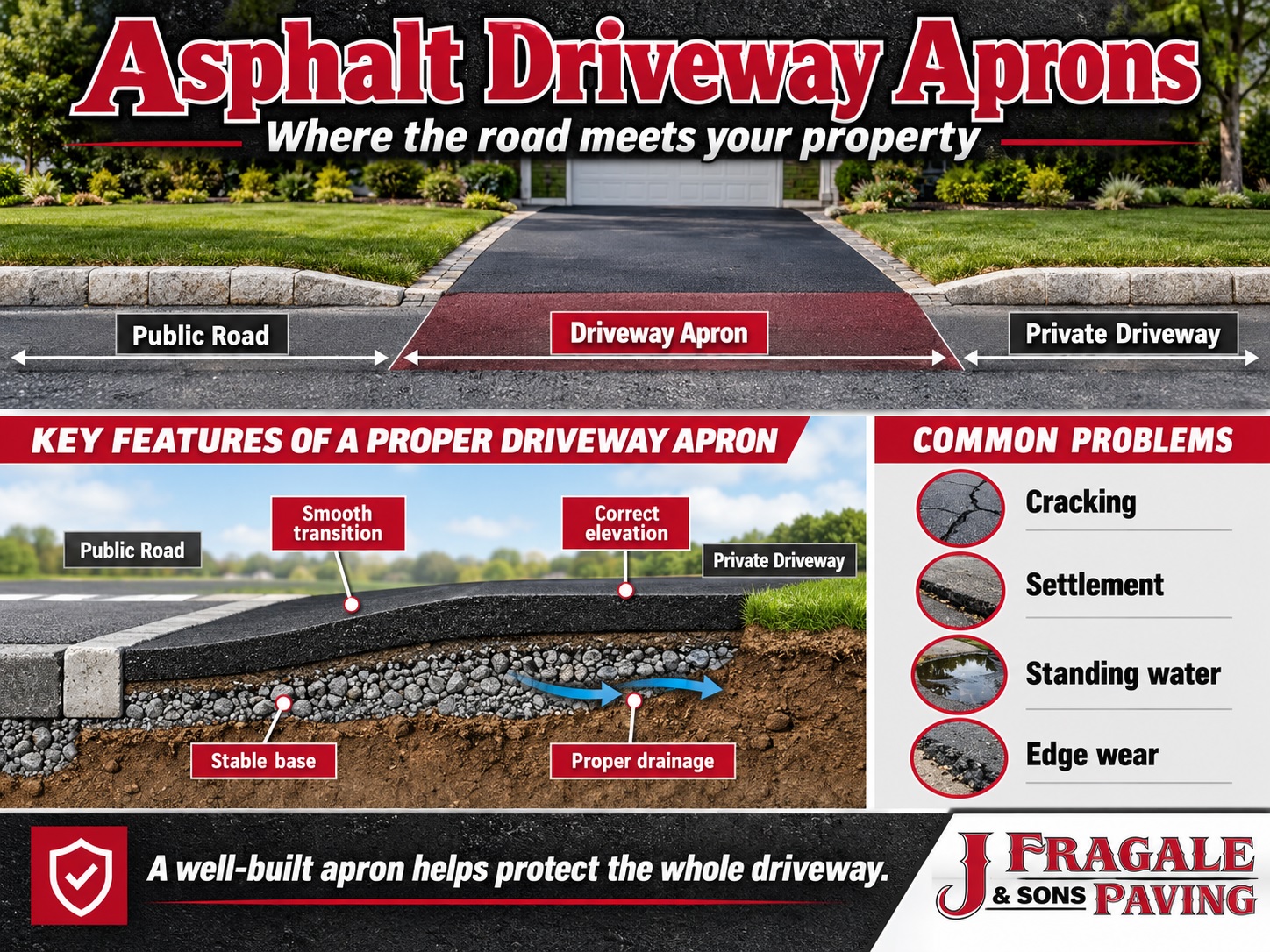
What Makes a Good Asphalt Driveway Apron?
A Stable Base
Asphalt needs structural support underneath it.
A weak, soft, or poorly compacted apron base can settle under traffic even when the asphalt surface initially looks smooth.
Our asphalt driveway paving process considers excavation, processed aggregate, grading, drainage, and compaction before asphalt placement.
We often describe asphalt as laminating the base underneath it. Blacktop cannot correct unstable soil or poorly compacted gravel after the fact.
Proper Elevation
The apron needs to meet the road at the correct height.
An apron that sits too high can create a noticeable bump and may leave an edge vulnerable to snowplows.
An apron that sits too low can create a depression where water collects.
The transition needs to be established during grading rather than corrected with a thin layer of asphalt at the end.
Good Compaction
The road entrance receives concentrated traffic.
Proper compaction helps the asphalt and underlying aggregate resist settlement, rutting, and edge movement.
Compaction becomes especially important where vehicles turn while entering or leaving the driveway.
How Drainage Affects a Driveway Apron
Water is one of the biggest considerations where a driveway meets the street.
The apron may interact with road crown, roadside drainage, gutters, shoulders, and the slope of the private driveway.
Poor grading can create:
- Standing water at the road
- Water flowing down the driveway
- Erosion along apron edges
- Ice at the entrance
- Saturated base material
- Premature cracking or settlement
Connecticut freeze-thaw cycles make these drainage issues even more important. Water entering the pavement structure can freeze, expand, thaw, and weaken support beneath the asphalt.
Why Driveway Aprons Crack or Sink
Apron deterioration can have several causes.
Common problems include:
Weak Base Material
Insufficient or unstable aggregate can compress under vehicle loads.
Poor Compaction
Loose material continues settling after paving.
Drainage Problems
Water can weaken the base and surrounding soil.
Heavy Vehicles
Delivery trucks, trailers, construction equipment, and other heavy vehicles place greater loads on the road entrance.
Road Edge Movement
The driveway and roadway may not move at exactly the same rate.
Freeze-Thaw Conditions
Seasonal movement can stress the joint between road and driveway.
Repairing only the visible crack may not solve a problem that begins underneath the asphalt.
Asphalt Apron vs. Concrete Apron
Not every property uses the same apron material.
Asphalt aprons create a continuous blacktop appearance, are flexible, and integrate naturally with asphalt driveways.
Concrete aprons create a rigid transition and may be required or preferred in certain developments or municipalities.
When asphalt meets an existing concrete apron, the joint deserves careful attention. The asphalt should meet the concrete at a practical elevation with stable support and drainage.
Our related guide to seamless driveway transitions covers asphalt connections at concrete aprons, garage slabs, and other hardscape edges.
Does a Driveway Apron Require a Permit in Connecticut?
It can. Requirements depend on which road serves the property and where the work occurs.
Connecticut DOT regulates work affecting state highway rights-of-way. State regulations address driveway approaches, drainage, safety, dimensions, and work performed within the right-of-way. CTDOT also operates an encroachment permit process that includes driveway repaving activities.
For town-maintained roads, municipal public works, engineering, or zoning requirements may apply instead.
Homeowners should not assume that the edge of visible road pavement is necessarily the property line.
For work involving a state road, review the Connecticut DOT encroachment permit guidance.
Can We Replace Only the Driveway Apron?
Sometimes.
Localized apron replacement may make sense when the road entrance has deteriorated but the remaining driveway and base are still structurally sound.
A contractor may need to evaluate:
- Condition of surrounding asphalt
- Base stability
- Drainage
- Elevation at the road
- Width of damaged pavement
- Existing curb or shoulder
- Settlement
- Right-of-way requirements
If deterioration extends farther into the driveway, a larger repair or replacement may provide better long-term performance.
Should the Apron Be Rebuilt When the Driveway Is Replaced?
Often, yes, especially when the existing apron has settlement, poor drainage, cracking, or an improper transition.
A full driveway replacement gives us an opportunity to establish grades from the road entrance through the rest of the property instead of treating the apron as a separate patch.
That helps create smoother vehicle access and more predictable water movement.
Build the Transition From the Ground Up
A driveway apron may represent only a small portion of the total paved area, but it handles some of the highest stress.
At J. Fragale & Sons Paving, we evaluate the road connection, base, drainage, pitch, compaction, surrounding pavement, and overall driveway before recommending the repair.
For properties throughout Torrington, Litchfield County, Hartford County, and Northwest Connecticut, our goal is a smooth road-to-driveway transition supported by proper preparation underneath.
Frequently Asked Questions
What is a driveway apron?
A driveway apron is the transition area where a private driveway meets the road, curb, gutter, sidewalk, or public right-of-way.
How long is an asphalt driveway apron?
There is no universal apron length. Dimensions can depend on the road, right-of-way, municipal requirements, drainage, and property design.
Why is my driveway apron sinking?
Common causes include weak base material, poor compaction, drainage problems, heavy vehicle loads, and freeze-thaw movement.
Can an asphalt driveway apron be repaired separately?
Yes, when the damage is localized and the surrounding pavement and base remain structurally sound.
Who is responsible for a driveway apron in Connecticut?
Responsibility can depend on property boundaries, road ownership, and local or state requirements. Work in a public right-of-way should be confirmed with the applicable road authority before construction.