
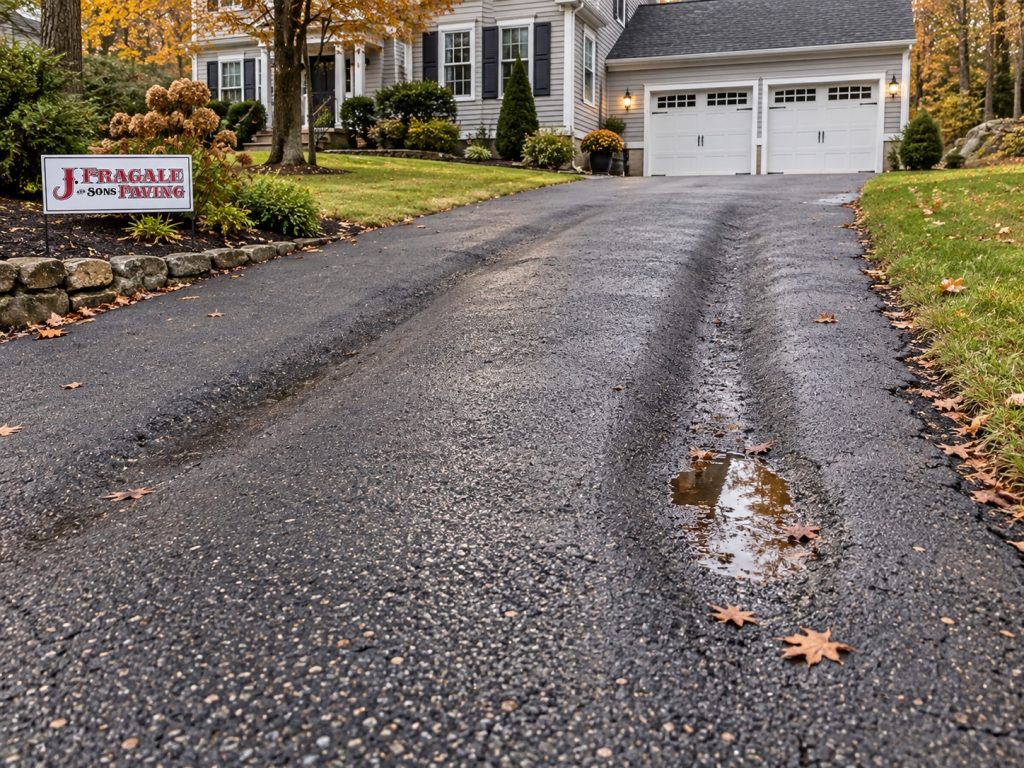
Asphalt rutting happens when repeated vehicle loads create permanent depressions in wheel paths. Some ruts develop because the asphalt surface itself deforms, while others form because the processed gravel base, subbase, or soil underneath has weakened or settled. Deep or recurring ruts often require more than surface patching. The correct repair depends on which pavement layer actually failed.
When two sunken tire tracks begin appearing in a driveway or parking lot, the problem may look like simple surface damage. In many cases, the real cause can be several inches below the blacktop.
That distinction matters because asphalt rutting is a symptom, not one single type of pavement failure.
What Is Asphalt Rutting?
Asphalt rutting is permanent pavement deformation that develops along the wheel paths where vehicles repeatedly travel or park.
Homeowners may notice:
- Two depressed tire tracks
- Asphalt pushed slightly upward beside the rut
- Standing water collecting in wheel paths
- Uneven pavement beneath parked vehicles
- A driveway that feels sunken where tires normally sit
Rutting is different from cracking. Cracks are fractures or separations in the pavement. Rutting is a change in the pavement’s shape.
Why Does Asphalt Develop Tire Ruts?
Several conditions can cause driveway tire ruts and parking lot rutting.
Heavy Vehicle Loads
Repeated traffic from pickup trucks, delivery vehicles, garbage trucks, RVs, construction equipment, and commercial vehicles can place significant stress on pavement.
Heavy loading becomes especially important when the pavement structure was not originally designed for repeated truck traffic.
Vehicle weight alone, however, does not prove the installation was defective. Load, pavement thickness, base support, drainage, and compaction all work together.
Weak or Inadequate Base
Asphalt depends on the material underneath it for structural support.
If the aggregate base is too thin, poorly compacted, saturated, contaminated, or unevenly settled, the blacktop above can follow that movement.
This is why proper driveway base preparation matters as much as the asphalt surface itself. At J. Fragale & Sons Paving, our paving work can include excavation, grading, base preparation, asphalt placement, and maintenance rather than treating pavement as only a surface layer.
Poor Drainage
Yes, poor drainage can contribute to asphalt rutting.
Water can reduce the strength of the material supporting the pavement. Once the base becomes wet and unstable, repeated vehicle loading can compress or move it.
The cycle can look like this:
Water enters the pavement structure → base loses support → traffic causes settlement → asphalt sinks → water collects in the rut → deterioration accelerates.
Connecticut’s seasonal freeze-thaw conditions can make moisture problems even more important.
Asphalt Mix Deformation
Sometimes the underlying base remains reasonably stable while the asphalt layer itself deforms.
Contributing factors can include excessive heat, heavy loading, insufficient density, or an asphalt mixture that does not have enough stability for the traffic it receives.
Poor Compaction
Compaction matters throughout the pavement structure.
That includes the native subgrade, processed gravel base, and asphalt surface.
If one of these layers continues compacting under vehicle loads after installation, the wheel paths may gradually sink.
Surface Rutting vs. Base Failure
The shape of the rut can provide clues, but appearance alone does not confirm which layer failed.
| Type | Typical Appearance | Likely Source | Repair Direction |
|---|---|---|---|
| Surface rutting | Narrow depressions directly beneath tires | Asphalt layer | Evaluate corrective asphalt removal or paving |
| Base rutting | Broader wheel-path depression | Aggregate base or subbase | Remove pavement and repair supporting base |
| Subgrade rutting | Wider, deeper settlement | Native soil | Structural excavation and reconstruction |
| Localized depression | Small isolated low area | Settlement, drainage, or construction issue | Diagnose affected layers |
The correct repair depends on which layer has lost stability.
Why Does My Driveway Rut Where Cars Park?
Repeated parking puts the same tire loads on the same sections of pavement every day.
Rutting in these areas can develop when:
- Asphalt is too thin for the loads
- Base depth is insufficient
- Processed gravel was not properly compacted
- Native soil is soft or unstable
- Drainage keeps the base wet
- Heavy vehicles use an area built for lighter traffic
- The asphalt mixture itself deforms
This is why a sunken asphalt driveway should be evaluated as a complete pavement system.
Why Do Parking Lots Develop Ruts?
Commercial parking lot rutting often appears where traffic is concentrated.
Common locations include loading zones, delivery entrances, dumpster routes, drive-thru lanes, bus areas, main travel lanes, and locations where vehicles repeatedly brake or turn.
Deeper ruts can create additional problems, including standing water, rough vehicle movement, snowplow complications, drainage issues, and accelerated pavement deterioration.
For commercial properties with repeated wheel-path failure, both traffic demand and pavement structure need to be considered.
Can Sealcoating Fix Asphalt Ruts?
No. Sealcoating cannot rebuild a failed base or raise pavement that has already sunk.
Sealcoating is valuable for protecting an asphalt surface, but it cannot:
- Recompact weak base material
- Raise a depressed wheel path
- Replace failed asphalt
- Correct grading
- Restore structural support
If a rut is structural, coating over it only covers the visible surface.
Can Asphalt Ruts Be Filled?
Simply filling a depression may not solve the underlying cause.
If the pavement underneath continues moving, the repaired area can sink again, crack around its edges, separate from surrounding asphalt, or continue collecting water.
Localized professional asphalt driveway repair may make sense when the damage is limited, surrounding pavement remains stable, and the failed material can be removed deeply enough to reach sound support.
When Does Rutting Require Full-Depth Repair?
Full-depth repair becomes more likely when:
- Ruts repeatedly return
- Base material is saturated
- Pavement flexes under traffic
- Deep settlement is visible
- Several wheel paths are affected
- Alligator cracking appears with rutting
- Water continually collects in depressions
- Base or subgrade failure is discovered
- Vehicle loads exceed the original pavement design
In these cases, resurfacing the blacktop without correcting the supporting layers may only provide a temporary improvement.
Rutting vs. Alligator Cracking
Rutting creates permanent depressions along wheel paths.
Alligator cracking creates interconnected fatigue cracks that can indicate inadequate structural support.
The two problems can occur together. When rutting is accompanied by widespread alligator cracking, the pavement structure may have experienced repeated movement or loading beyond its available support.

Rutting vs. Asphalt Shoving
These are also different forms of asphalt deformation.
Rutting runs primarily in the direction of vehicle travel.
Shoving occurs when pavement pushes or bulges, often in areas where vehicles frequently brake, accelerate, or turn.
Identifying the type of deformation helps determine where the failure may be occurring.
How Proper Base Preparation Helps Prevent Rutting
Good asphalt starts underneath the asphalt.
Long-lasting pavement depends on:
- Removing unsuitable material
- Establishing proper grade
- Installing appropriate processed aggregate
- Building adequate base depth
- Compacting material in controlled lifts
- Managing drainage
- Matching pavement structure to expected vehicle loads
- Proper asphalt placement and compaction
For more extensive problems, J. Fragale & Sons can address both the visible pavement and the supporting structure rather than repeatedly treating the surface.
Connecticut Freeze-Thaw Cycles Make the Base Especially Important
Water entering an already weak pavement structure can create additional stress during Connecticut’s seasonal temperature changes.
A properly built processed-gravel base, good drainage, and controlled compaction help pavement withstand repeated traffic and freeze-thaw conditions.
That is why the foundation beneath a driveway or parking lot should be considered whenever rutting keeps returning.
Repair the Failed Layer, Not Just the Visible Rut
A tire-track depression may appear to be a blacktop problem even when the actual failure lies deeper in the aggregate base or native soil.
Before choosing patching, resurfacing, or reconstruction, we look at the pavement’s base condition, drainage, settlement, traffic loads, compaction, and extent of deformation.
J. Fragale & Sons Paving provides asphalt paving and repair throughout Torrington, Litchfield County, Hartford County, and Northwest Connecticut, with services that include excavation, grading, pavement preparation, asphalt paving, patching, and maintenance.
Request a pavement evaluation and paving estimate to determine which layer needs to be repaired.
Frequently Asked Questions
What causes ruts in an asphalt driveway?
Rutting occurs when repeated wheel loads permanently deform the asphalt, aggregate base, subbase, or soil underneath. Heavy traffic, weak base material, moisture, poor compaction, drainage problems, and asphalt instability can all contribute.
Can asphalt driveway ruts be repaired?
Yes. The repair depends on which pavement layer failed. Surface deformation may require asphalt removal and replacement, while base or subgrade failure can require deeper excavation and reconstruction.
Will sealcoating fix tire ruts?
No. Sealcoating protects the asphalt surface but cannot raise sunken pavement, recompact a weak base, or restore structural support.
Why does my driveway sink where the cars park?
Repeated loads may be deforming the asphalt, processed gravel, or soil beneath the pavement. Persistent depressions should be evaluated to determine which layer is losing support.
Can standing water make asphalt rutting worse?
Yes. Moisture can weaken underlying pavement materials, allowing traffic loads to produce additional deformation.
Do heavy trucks cause asphalt rutting?
Heavy vehicles can contribute to rutting, especially when the pavement structure was not designed for repeated truck loads.