
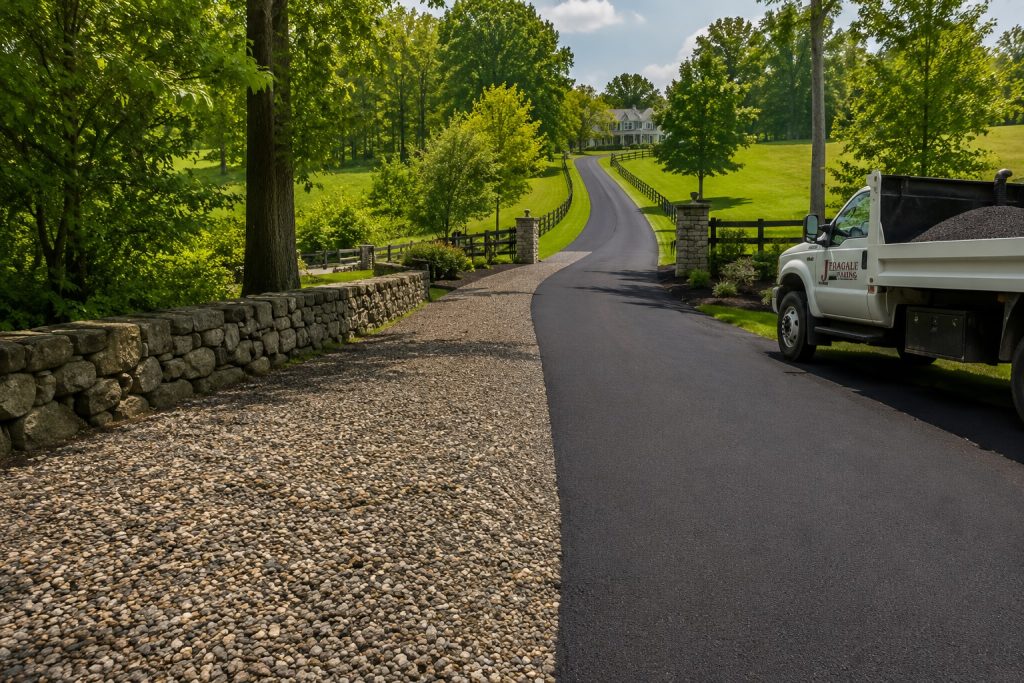
Tar and chip usually offers a lower initial cost and a more rustic appearance than hot mix asphalt, making it attractive for long rural driveways and private roads. Hot mix asphalt generally provides a smoother surface, longer service life, easier snow removal, and better performance under frequent traffic. Chip seal performs best when installed over a stable, properly graded base, but it does not correct deep settlement or weak subgrade conditions. Federal guidance describes chip seal as asphalt binder covered with aggregate and rolled into place, while hot mix asphalt combines heated binder and aggregate into a compacted pavement layer.
For property owners in Warren, Goshen, Litchfield, and other rural Connecticut communities, paving 500 feet or more can represent a major investment. We recommend comparing the complete pavement structure rather than focusing only on the surface price. Drainage, grading, base depth, vehicle weight, slope, and winter maintenance can matter more than the selected finish.
Chip Seal vs. Hot Mix Asphalt Driveway Comparison
| Factor | Tar and Chip | Hot Mix Asphalt |
|---|---|---|
| Initial price | Usually lower | Usually higher |
| Appearance | Rustic and stone-like | Smooth and uniform |
| Typical application | Long driveways and low-volume roads | Driveways, roads, and commercial surfaces |
| Surface texture | Coarse with strong traction | Smooth and comfortable |
| Snow removal | Requires careful plowing | Easier to plow |
| Loose stone | Possible during early service | Minimal |
| Color options | Depends on selected aggregate | Primarily dark black to gray |
| Structural strength | Depends heavily on the base | Provides a compacted pavement layer |
| Surface life | Common preservation range of 5 to 10 years | Asphalt pavement studies report longer average service life |
Federal Highway Administration guidance explains that chip seal is commonly used to seal surfaces, reduce water intrusion, improve friction, and serve as a wearing course on low-volume roads. It should not be confused with a full structural asphalt replacement.
What Is a Tar and Chip Driveway?
Tar and chip, also called chip seal or oil and stone, starts with an application of asphalt binder. Selected stone aggregate is spread over the binder and rolled so the stone becomes embedded.
The result has a natural, textured appearance that fits farm estates, wooded properties, historic homes, and long private roads. Stone color can be selected to coordinate with the house, retaining walls, or surrounding landscape.
Our chip seal paving guide explains how binder and aggregate form the finished wearing surface. We install stone and gravel driveways for properties where a fully paved surface may not be necessary.
Tar and Chip Driveway Cost Per Square Foot
There is no reliable universal tar and chip driveway cost per square foot for Connecticut properties. A low price for surface material can become misleading when the project also requires excavation, drainage correction, imported aggregate, base rebuilding, widening, or extensive grading.
The most important pricing factors include:
- Total square footage
- Existing base condition
- Driveway length and width
- Steep grades or tight curves
- Drainage and culvert work
- Number of chip-seal applications
- Aggregate type and color
- Equipment access
- Distance from the asphalt and stone suppliers
Chip seal usually costs less than installing a complete hot mix asphalt surface over the same prepared base. However, placing chip seal over unstable gravel does not solve rutting, soft areas, or frost movement. Proper excavation and grading must come first when the foundation has failed.
Which Surface Lasts Longer?
Published pavement-preservation guidance places the typical life of a chip-seal treatment at approximately five to ten years, depending on climate, traffic, pavement condition, aggregate, binder, and installation quality. Multiple chip-seal applications may create a harder-wearing surface than a single application.
Hot mix asphalt generally provides the longer structural service life. Asphalt Pavement Alliance research reports an average of about 18 years without maintenance for new asphalt pavements, while another industry study found average expected service life greater than 20 years for conventional and deep-strength flexible pavements. Those roadway figures are not guarantees for residential driveways, but they illustrate why properly built asphalt is selected for heavier and more frequent traffic.
Our asphalt paving services include preparation and paving for driveways, private roads, commercial properties, and municipal surfaces.
Is Tar and Chip Better Than Gravel?
Tar and chip can be better than loose gravel when the goal is to reduce dust, washouts, migration, and recurring grading. The asphalt binder helps hold the surface stone in place while preserving a natural appearance.
Gravel may remain the better choice for very long access roads with limited traffic or properties requiring the lowest practical initial investment. It is also easier to reshape and add material to after storm damage. However, untreated gravel can develop potholes, washboarding, ruts, and displaced stone.
Performance on Hills and Curves
The coarse texture of chip seal can provide useful traction on inclines and curved rural driveways. FHWA guidance identifies improved pavement friction as one of the treatment’s primary benefits.
Hot mix asphalt still offers a more controlled, uniform surface for frequent vehicle use, delivery trucks, trailers, and snow-removal equipment. A steep site also requires careful drainage design because water running beneath either surface can weaken the base.
Snowplowing a Tar and Chip Driveway
Chip seal can be plowed, but the operator should avoid scraping aggressively into the aggregate. Raising the blade slightly, using skid shoes, or fitting a protective cutting edge can reduce stone displacement.
Aggregate shape and embedment matter. Minnesota Department of Transportation guidance notes that rounded aggregate is more vulnerable to snowplow damage and that proper embedment helps prevent chips from being dislodged.
Choosing a Private Road Paving Option in Connecticut
We generally recommend tar and chip when a property owner wants a rustic finish, good surface traction, and a lower initial investment for a long, low-volume driveway. Hot mix asphalt is usually the stronger choice when smoothness, longevity, regular snowplowing, heavy vehicles, and minimal loose stone are priorities.
The right private road paving option in Connecticut begins below the visible surface. At J. Fragale & Sons Paving, we evaluate drainage, grades, soil conditions, base stability, traffic, and winter maintenance before recommending asphalt, chip seal, or stone.