
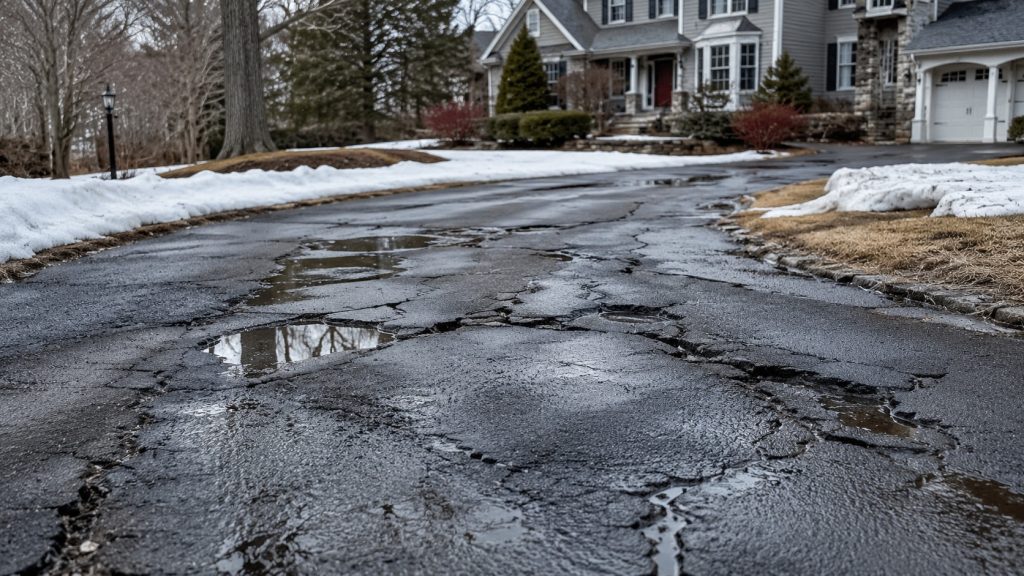
Every spring, homeowners across Litchfield, Avon, Torrington, Simsbury, Canton, Granby, and nearby Connecticut towns start asking the same frustrating question: why is my driveway cracking? The asphalt looked fine before winter, then snow melts, the ground softens, and cracks, bumps, dips, or raised sections suddenly appear.
At J. Fragale & Sons Paving, we see this pattern often. A driveway rarely fails because of the asphalt surface alone. Most frost heave driveway repair starts with what happened underneath the pavement months before the first crack showed up.
New England winter is tough on asphalt. Water gets into weak spots, settles into the gravel base, freezes, expands, and pushes the driveway upward. When that ice thaws, the base can settle unevenly, leaving the asphalt unsupported. That movement is what causes cracking, heaving, potholes, and premature driveway failure.
What Is a Frost Heave?
A frost heave happens when moisture in the ground freezes and expands below pavement. Pavement engineering resources describe frost heave as upward movement caused by frozen water in pavement layers or subgrade soils, followed by thaw weakening when the melted ice leaves the base saturated and weaker.
For a Connecticut driveway, that usually means three things are working against the asphalt:
- Water is getting into or under the driveway.
- The gravel base is inconsistent, poorly compacted, or holding moisture.
- The driveway does not drain properly during rain, snowmelt, or spring thaw.
Once those conditions exist, winter does the rest.
Why Is My Driveway Cracking After Winter?
Asphalt is flexible, but it still needs a strong, uniform base. If one section of the base freezes, lifts, and settles differently than another section, the surface bends. That bending creates stress cracks.
Common frost-related driveway damage includes:
- Long cracks running through the driveway
- Raised humps or uneven sections
- Depressions that collect water
- Edges breaking apart
- Potholes near low areas
- Cracks that return after patching
- Areas that feel soft during spring thaw
Asphalt cannot make up for an improper base layer or lack of drainage. The site specifically explains that inconsistent gravel can move unevenly during freezing conditions, causing the driveway to heave and crack.
That is why a quick surface patch may look good for a season but fail again when the base stays wet.
The Real Cause: Water Trapped in the Base
Water is the enemy of long-lasting asphalt. When rain, runoff, or snowmelt seeps through cracks or pools at the driveway edge, it can reach the gravel base. If that base is poorly graded, too thin, unevenly compacted, or full of fine material that holds moisture, it becomes vulnerable to frost movement.
The cycle looks like this:
- Water enters the driveway base.
- Cold temperatures freeze that trapped moisture.
- Frozen water expands and lifts the asphalt.
- Spring thaw softens the base.
- Traffic pushes weak areas down.
- Cracks widen and let in even more water.
That is how a small drainage problem turns into a full frost heave driveway repair.
Why Cheap Patches Do Not Fix Frost Heaves
A patch can help with surface damage, but it does not fix a failing base. If the gravel underneath is still wet, loose, or uneven, the same section can keep moving every winter.
Surface-only repairs may fail when:
- The driveway still pitches toward a low area
- Water still pools near the same crack
- The base has settled below the asphalt
- The gravel layer was never compacted properly
- The edge has no support
- Drainage was never corrected
- Old cracks were sealed without removing the cause
This is why our approach looks beyond the topcoat. Before asphalt is installed, the driveway needs proper excavation, grade correction, drainage planning, and compacted base preparation.
How Proper Excavation Prevents Frost Heaves
The best asphalt driveway drainage solutions start before paving. A strong driveway begins with removing weak material and building a base that drains and supports the asphalt evenly.
Prepare the site before paving by removing old material, stones, roots, and poor soil, while also handling grading and drainage needs. Excavation and drainage services help make a driveway ready for paving, instead of forcing homeowners to coordinate multiple contractors.
Professional excavation allows our crew to correct issues such as:
- Soft subgrade
- Organic material under the driveway
- Rock or stump interference
- Low areas that trap water
- Poor driveway slope
- Weak edges
- Inconsistent gravel depth
- Improper transition areas near garages, roads, or walkways
Without that prep, even a fresh asphalt surface can fail early.
The Gravel Base: The Part Homeowners Never See but Always Pay For
The gravel base is the foundation of the driveway. A properly built base spreads vehicle weight, allows water to drain, and helps the asphalt move evenly through freeze and thaw cycles.
Preparation is critical because asphalt is only as good as the base beneath it. A weak or uneven base leads to failure.
A frost-resistant driveway base should be:
- Excavated to the correct depth
- Built with quality gravel or crushed stone
- Installed evenly across the full driveway
- Compacted in layers
- Pitched for water movement
- Free of soft soil, roots, and debris
- Supported along the edges
- Matched to the property’s grade and drainage pattern
This is where premium paving work separates itself from a cheap overlay. The surface is what homeowners see. The base is what decides how long the driveway lasts.
Smart Pitching: Moving Water Away Before It Freezes
A driveway should not hold water. When water ponds on the surface, sits along the edges, or runs toward the garage, it eventually finds its way into cracks, joints, and low spots.
Smart pitching uses grade to move water away from the asphalt and toward a controlled drainage path. That may include:
- Regrading the driveway slope
- Creating a crown or cross slope
- Directing water away from the garage
- Building up low edges
- Adding drainage stone
- Installing drainage solutions where needed
- Connecting the driveway grade to the yard grade
Drainage is a crucial part of asphalt performance because pooled water can seep into the layers, absorb into the base, loosen the base, and lead to cracking or heaving during freeze and thaw cycles.

When Asphalt Driveway Drainage Solutions Are Needed
Some properties need more than proper slope. Hillside driveways, long private roads, shaded areas, clay soil, and low spots near the street may require dedicated drainage planning.
Drainage solutions may be needed when:
- Water runs across the driveway during storms
- The bottom of the driveway stays wet
- Ice forms in the same area every winter
- The garage apron cracks repeatedly
- Gravel washes out along the edge
- Puddles remain after rain
- The driveway meets a steep road or private lane
- Cracks keep reopening after sealing
Our team can evaluate whether grading, drainage stone, culverts, trenching, or other site adjustments are needed before paving begins.
Warning Signs Your Driveway Base Is Failing
Homeowners searching ct paving contractors near me often know something is wrong but are not sure whether the driveway needs repair, resurfacing, or full replacement.
Watch for these warning signs:
| Warning Sign | What It Could Mean |
|---|---|
| Cracks return every spring | Water may be reaching the base |
| Humps or raised sections | Frost heave may be pushing asphalt upward |
| Low spots or puddles | Poor pitch or base settlement |
| Crumbling edges | Weak edge support or drainage washout |
| Repeated potholes | Base failure under the asphalt |
| Garage apron separation | Movement near transition points |
| Alligator cracking | Weak base or structural failure |
| Water flows toward the house | Drainage correction may be needed |
For minor surface damage, asphalt driveway repair or asphalt maintenance may be enough. For structural base failure, the long-term fix usually requires excavation and proper prep before new asphalt goes down.
Why Base Prep Was Worth an AsphaltPro Feature
J. Fragale & Sons Paving has built its reputation around preparation. Our preparation process and best practices were featured in AsphaltPro Magazine, with the article emphasizing quality base work, water problem correction, and proper grade as major parts of long-lasting paving.
That matters for homeowners because driveway failure is rarely random. A driveway that cracks, sinks, or heaves every spring is often telling the same story: water was never fully controlled below the surface.

Repair, Resurface, or Replace?
Not every cracked driveway needs full replacement. The right solution depends on the condition of the asphalt, the base, and the drainage.
Repair May Make Sense When:
- Cracks are isolated
- The driveway still drains well
- The base feels stable
- Damage is limited to surface wear
- The driveway is not heaving or sinking
Resurfacing May Make Sense When:
- The asphalt surface is worn
- The base is still solid
- Drainage is acceptable
- There are no major frost heave sections
- The driveway needs a fresh top layer
Replacement May Make Sense When:
- Frost heaves return every year
- The driveway has widespread cracking
- Water collects in low spots
- The base is soft or uneven
- Edges are breaking apart
- The driveway was built on poor material
- Drainage needs to be redesigned
A professional evaluation helps avoid spending money on the wrong fix.
How Homeowners Can Reduce Frost Heave Damage
Homeowners can protect the driveway by keeping water away from the asphalt as much as possible.
Use these habits:
- Keep cracks sealed before winter.
- Clean leaves and debris from driveway edges.
- Keep gutters from draining onto the driveway.
- Avoid snow piles that melt into low spots.
- Watch where water flows during heavy rain.
- Repair potholes before freeze and thaw cycles worsen them.
- Schedule professional maintenance before small cracks spread.
- Ask about base and drainage if replacement is being considered.
The goal is simple: keep water out, keep the base stable, and keep the asphalt supported.
Built for Connecticut Winters, Not Just Closing Day
A driveway should look good when the paving crew leaves, but the real test comes after winter. New England freeze and thaw cycles expose shortcuts fast. If the base is inconsistent, if the gravel holds water, or if the grade sends runoff into the driveway, spring will show it.
At J. Fragale & Sons Paving, our process focuses on the part that keeps the driveway strong after the first season. From excavation and prep for paving to full asphalt paving, driveway repair, maintenance, and stone and gravel driveway options, our team helps Connecticut homeowners solve the water and base problems before the topcoat is ever laid down.
FAQs
Why is my driveway cracking after winter?
Your driveway may be cracking after winter because water entered the asphalt or gravel base, froze, expanded, then thawed and left the base weak or uneven. Poor drainage and inconsistent base compaction are common causes.
What is frost heave driveway repair?
Frost heave driveway repair addresses asphalt that has lifted, cracked, or settled because moisture froze beneath the surface. A lasting repair often requires correcting the base and drainage, not just patching the surface.
Can asphalt driveway drainage solutions prevent frost heaves?
Yes. Proper grading, pitching, drainage stone, culverts, and base preparation can help move water away from the driveway before it freezes beneath the asphalt.
Should a cracked driveway be patched or replaced?
A cracked driveway may only need repair if the damage is minor and the base is stable. If the driveway has widespread cracking, heaving, soft spots, or drainage problems, replacement with proper excavation and base prep may be the better long-term option.
What makes a driveway last longer in Connecticut?
A long-lasting Connecticut driveway needs proper excavation, a uniform compacted gravel base, smart water drainage, quality asphalt installation, and routine maintenance such as crack filling and seal coating.
Who should homeowners call for CT paving contractors near me?
Homeowners in Torrington, Litchfield, Avon, Simsbury, Canton, Granby, and nearby Connecticut towns can contact J. Fragale & Sons Paving for asphalt paving, driveway repair, excavation, drainage, prep for paving, and maintenance.