The best time to sealcoat a driveway in Connecticut is during a dry stretch from late spring through early fall, when pavement and air temperatures are at least 50°F and expected to remain above 50°F for at least 24 hours. The asphalt must be dry, clean, structurally sound, and free from rain during the curing period. New asphalt should never be sealed immediately. Although 90 to 180 days is commonly treated as a minimum curing window, a properly constructed driveway may not need its first sealcoat for two to five years. Surface condition should guide the schedule. We also recommend asphalt-emulsion sealer instead of coal-tar products because Connecticut health officials identify asphalt-based coatings as the safer, lower-PAH alternative.
Connecticut asphalt faces summer sunlight, winter moisture, freeze-thaw cycles, vehicle traffic, and petroleum drips. Over time, oxidation changes a dark, flexible surface into faded gray pavement that becomes more brittle and vulnerable to aggregate loss.
At J. Fragale & Sons Paving, we use sealcoating as part of a complete pavement maintenance plan, not as a cosmetic cover for structural damage.
What Is the Best Time to Sealcoat a Driveway in CT?
The most dependable sealcoating season usually runs from late May through September. Warm, dry weather allows water within an asphalt-emulsion coating to evaporate so the protective film can form correctly.
Professional specifications generally require:
- Air and pavement temperatures of at least 50°F and rising
- Temperatures remaining above 50°F for at least 24 hours
- A dry pavement surface
- No imminent rain or heavy moisture
- Enough daylight and curing time before vehicle traffic returns
Temperatures near the minimum may lengthen curing time. A warm afternoon does not guarantee suitable conditions when the forecast calls for a cold Connecticut night.
How Long After New Asphalt Can You Sealcoat?
A new driveway needs time for volatile oils to leave the pavement and for the asphalt surface to cure. Sealing too early can trap oils, interfere with bonding, and create a coating that wears unevenly.
Many contractors use 90 to 180 days as the earliest possible window. That should not be treated as an automatic application date. The Asphalt Institute states that a well-designed, properly constructed residential driveway or low-traffic parking area may not require sealing for approximately two to five years. Sealing becomes useful when the surface starts showing dryness, brittleness, small voids, minor raveling, or oxidation.
Before recommending the first coat, we inspect:
- Surface color and oxidation
- Porosity and exposed aggregate
- Oil contamination
- Hairline cracking
- Drainage and standing water
- Soft spots or base failure
Sealcoat cannot stabilize a sinking driveway, repair potholes, or correct failed pavement. Those conditions require asphalt driveway repair before coating begins.
Asphalt Emulsion vs. Coal Tar Sealer
Asphalt Emulsion
Asphalt-emulsion sealer combines asphalt binder, water, emulsifying agents, mineral fillers, and optional polymers or additives. It provides a dark protective coating without the high polycyclic aromatic hydrocarbon concentration associated with coal-tar sealers.
Connecticut’s Department of Public Health recommends choosing asphalt-based products instead of coal-tar sealants. The agency reports that coal-tar coatings can release carcinogenic PAHs as the surface breaks down through traffic and weathering.
Asphalt emulsion offers:
- Lower PAH content
- Less objectionable odor
- Good compatibility with asphalt pavement
- Flexible performance in changing temperatures
- A practical option for homes and commercial properties

Coal Tar
Coal-tar sealer was historically selected for resistance to fuel and chemical spills. However, USGS research identifies coal-tar pavement sealcoat as a potent source of PAH contamination. Asphalt-based sealcoat contains substantially lower PAH concentrations.
For Connecticut driveways and most parking areas, we prefer an asphalt-emulsion system supported by correct preparation and application rates.
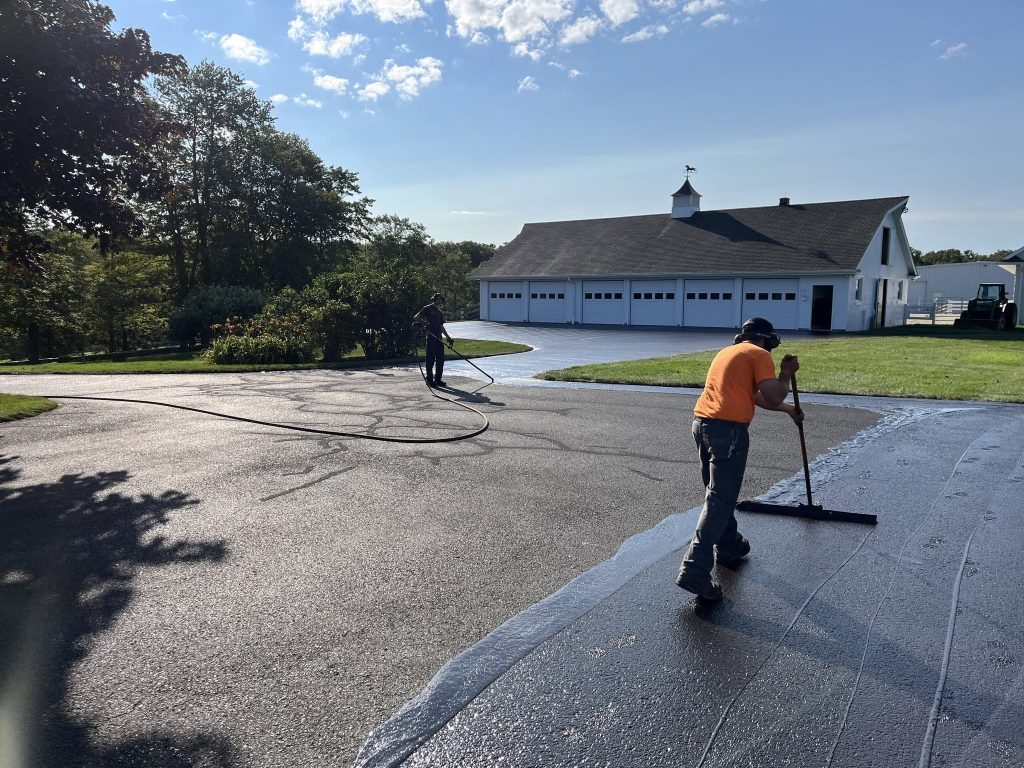
Spray vs. Squeegee Sealcoat Application
Both spray and squeegee methods can produce durable results when the product is mixed correctly and applied at the manufacturer’s specified rate.
Spray application creates a controlled, uniform film and works efficiently across large driveways and commercial parking lots. Correct nozzle pressure, overlap, and equipment calibration help prevent light spots and streaking.
Squeegee application pushes material into surface pores and can perform well as a first coat on older or more porous asphalt. Applying material too heavily does not automatically improve protection. Excess sealer may remain soft, track onto tires, or crack prematurely.
A combined system may use a squeegee coat for penetration followed by a spray coat for a consistent finish. The best method depends on pavement texture, porosity, traffic, and the selected product.
Prepare the Pavement Before Sealcoating
A long-lasting coating starts with preparation:
- Clean dirt, leaves, vegetation, and loose aggregate.
- Remove or prime oil-contaminated areas.
- Fill suitable cracks without overfilling them.
- Repair potholes, depressions, and broken edges.
- Allow repaired areas to cure.
- Apply thin, uniform coats at the approved rate.
- Keep vehicles off the surface until curing is complete.
Our asphalt maintenance services include sealcoating, crack filling, patching, and related pavement-preservation work for residential, commercial, and municipal properties. J. Fragale & Sons Paving provides asphalt work from excavation and base preparation through paving and long-term maintenance.
Schedule Driveway or Parking Lot Sealcoating
The right weather window, surface preparation, material, and application rate matter more than making a driveway look black for one season.
Contact J. Fragale & Sons Paving to schedule residential driveway sealcoating, commercial parking lot maintenance, crack filling, or an asphalt condition evaluation in Connecticut.