

To fix driveway drainage problems on a sloped Connecticut property, first identify where water enters, crosses, and exits the driveway. The lasting solution may involve correcting the driveway grade, rebuilding washed-out aggregate, forming a shallow swale, adding a French drain or catch basin, and protecting vulnerable edges with stone. Water must be directed toward a stable, lawful outlet without sending runoff toward the foundation, roadway, or neighboring property. Connecticut stormwater guidance emphasizes managing runoff near its source while reducing erosion and downstream impacts.
After heavy rain, a Connecticut driveway can reveal problems that remain hidden during dry weather. Gravel develops deep ruts, asphalt edges crumble, and nearby lawns stay wet long after the storm ends.
At J. Fragale & Sons Paving, we address more than the visible surface. Our team evaluates the grade, base, surrounding soil, and runoff path so the repair corrects the cause rather than covering the damage.
Warning Signs of a Driveway Drainage Problem
Homeowners often notice isolated damage without realizing that water connects every symptom.
Watch for:
- Puddles near the garage door
- Water flowing toward the foundation
- Deep channels across a gravel surface
- Loose stone collecting at the bottom of a hill
- Soft or muddy driveway shoulders
- Asphalt cracks near low areas
- Crumbling pavement edges
- A soggy lawn beside the driveway
- Sediment washing into the road
Recurring puddles suggest that the surface lacks positive drainage or has settled. Ruts show where concentrated runoff has gained enough speed to move gravel and expose the base.
Our guide to fixing a sinking driveway explains why wet, weak, or poorly drained base material can allow the driveway surface to settle.
Why Water Damages Asphalt and Gravel Driveways
Asphalt depends on a stable, well-drained aggregate foundation. When water enters cracks, reaches the base, and remains trapped, the supporting material can soften or move. Connecticut freeze-thaw cycles can then place additional stress on weakened pavement.
Gravel driveways fail differently. Fast-moving runoff carries loose surface stone downhill, forming washboard areas, channels, and exposed subgrade. Simply spreading new gravel over the damage rarely lasts when the original water path remains unchanged.
Proper driveway preparation includes grading and compaction that support both drainage and the finished surface. J. Fragale & Sons Paving provides excavation, fine grading, and gravel-driveway restoration for washed-out or rutted areas.
How Professional Grading Corrects the Water Flow
Professional grading reshapes the driveway and surrounding ground so runoff moves away from the garage, foundation, and weak pavement edges.
Depending on the property, the new profile may include:
- A consistent cross slope
- A crowned gravel surface
- Raised or rebuilt shoulders
- Removal of low spots
- A shallow diversion swale
- A controlled outlet near the bottom of the slope
The correct design depends on the driveway length, hill angle, soil, road elevation, and available discharge area. A laser or grading equipment can reveal subtle low sections that are difficult to detect by eye.
Homeowners searching for a driveway grading contractor in CT can review our excavation and grading services. We can remove failed material, reshape the site, compact the aggregate base, and prepare the area for asphalt, stone, or gravel.
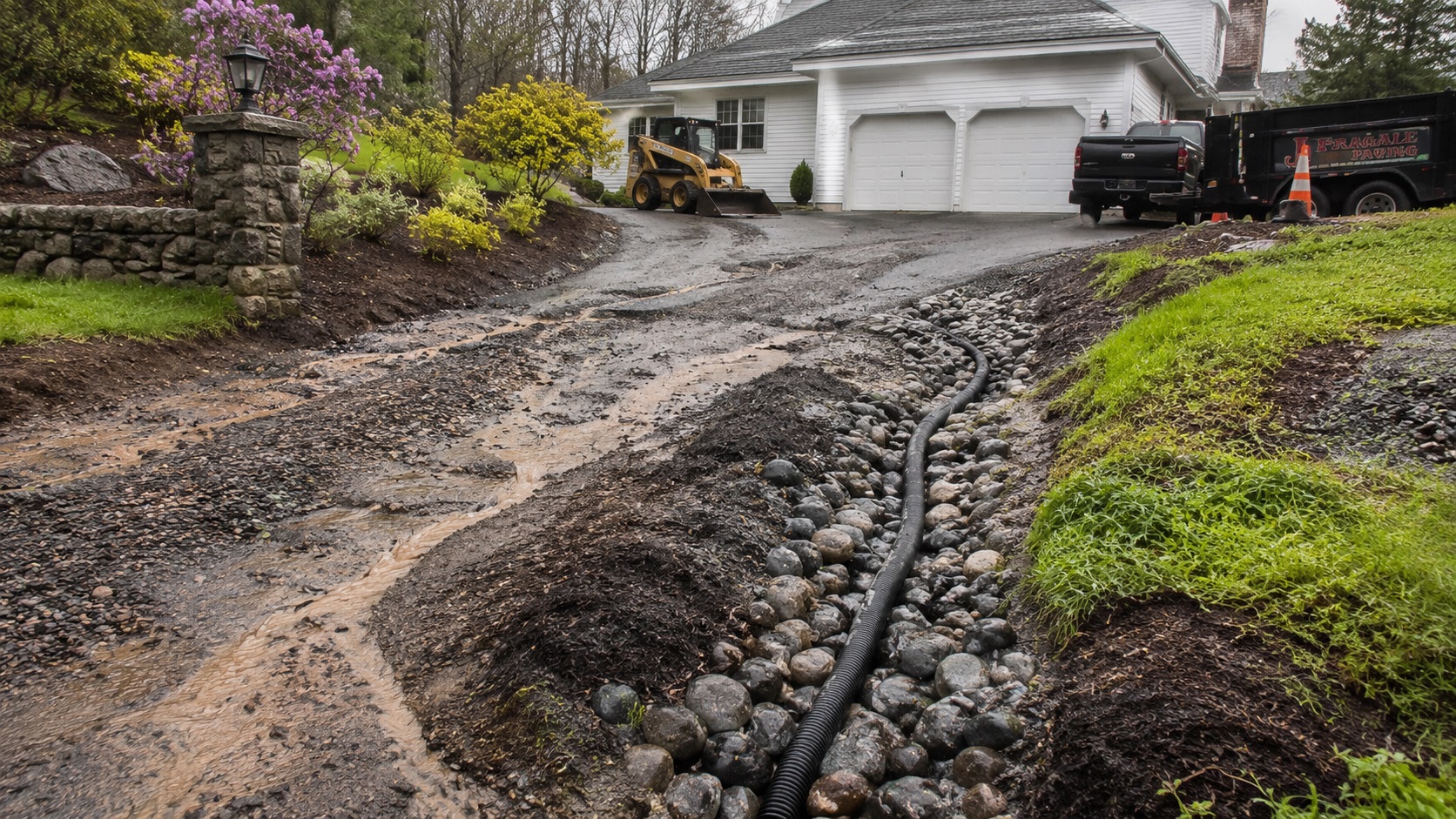
Gravel Driveway Washout Solutions
The best gravel driveway washout solutions combine surface restoration with runoff control.
Rebuild the Aggregate Base
Deep ruts may indicate that water has removed more than the decorative surface stone. Failed sections may need excavation, new crushed aggregate, grading, and mechanical compaction before the finish layer is restored.
Our stone and gravel driveway services include new driveways, private roads, restoration, and preparation for possible future paving.
Restore the Crown or Cross Slope
A gravel driveway should not act like a drainage ditch. A properly shaped surface encourages water to leave the travel lane before it gains enough speed to create long channels.
Stabilize the Edges
Stone borders, cobble edging, or reinforced shoulders can protect vulnerable transitions between the driveway and lawn. These features also create a finished New England appearance when integrated with the drainage plan.
Our landscape and hardscape services include cobble edging, curbing, retaining features, and other functional improvements.
When a Swale, French Drain, or Catch Basin Helps
Grading alone may not solve a property where runoff arrives from a roof, upper lawn, neighboring slope, or long hillside.
Swales
A swale is a shallow graded channel that slows and redirects surface water. It can be finished with grass, stone, or erosion-resistant plantings, depending on the expected flow.
French Drains
A French drain uses a perforated pipe surrounded by clean stone and filter fabric to collect and carry water below the surface toward a suitable outlet. It is often useful beside a driveway where saturated soil creates a soggy lawn or weak shoulder.
A French drain driveway installation must include a dependable discharge location. An underground pipe without adequate pitch or an outlet can fill with water and fail to correct the problem.
Catch Basins and Channel Drains
A catch basin can collect runoff at a defined low point. A channel drain may be appropriate where water crosses the driveway or gathers near a garage threshold. These systems require correct sizing, placement, and maintenance.
Connecticut regulations may affect connections or changes near public-road drainage. Runoff within a state highway right-of-way cannot be altered or impeded without suitable drainage provisions and approval.
Stop Repairing the Same Damage After Every Storm
Learning how to fix driveway drainage problems starts with following the water, not patching the lowest puddle.
At J. Fragale & Sons Paving, we combine excavation, grading, base preparation, paving, and stonework to create a complete solution for sloped properties. Our Torrington-based team serves homeowners across Northwest Connecticut with asphalt, stone, gravel, and drainage-related site preparation.
Contact our team to evaluate the slope before the next storm causes another washout.
Frequently Asked Questions
Why does water pool in front of the garage?
The driveway may have settled, been graded toward the building, or developed a low area near the slab. A channel drain, catch basin, or corrected grade may be needed.
Can new gravel fix a washed-out driveway?
New gravel restores the surface but will not stop recurring erosion unless the grade and runoff path are corrected.
Is a French drain always the best solution?
No. French drains address certain subsurface and collected-water problems. Surface runoff may be better managed with grading, swales, catch basins, or a combination of methods.
Who fixes driveway drainage problems?
A contractor experienced in excavation, grading, aggregate bases, and paving can assess both the driveway and surrounding terrain.